 HabitKeep
How to Track 75 Hard on Your iPhone
75 Hard is a 75-day mental toughness challenge with five non-negotiable daily tasks. Its defining rule is also its hardest one: miss any single task on any single day and you start over at day one. That makes accurate tracking less of a nicety and more of a requirement — “I think I did all five yesterday” isn’t good enough when it costs you two months.
The five daily tasks
- Two 45-minute workouts, one of which must be outdoors
- Follow a diet — any diet, no cheat meals, no alcohol
- Drink a gallon of water (about 3.8 litres)
- Read 10 pages of non-fiction
- Take a progress photo
They’re deliberately varied, and that variety is exactly why a single checkbox labelled “75 Hard” doesn’t work. Each task wants to be tracked in a different way.
Try HabitKeep
Build better habits, keep the streak alive, and stick to your routine.
Set each task up as its own habit
The trick is matching each task to the tracking style that fits it, so logging takes one tap rather than a note to yourself.
The two workouts are a step-by-step count with a goal of 2, not a checkbox. Tapping it once after the morning session leaves it visibly half-finished all day, which is a much better reminder than a box you’re fairly sure you already ticked. Keep the outdoor one as its own habit if you’re likely to fudge it — the whole point of the rule is that it’s the inconvenient one.
A gallon of water is a step-by-step count too. Set the goal to however many glasses or bottles a gallon works out to for you — 8 pint glasses, 4 one-litre bottles — so each tap corresponds to something you actually drank. If you log water in Apple Health already, point the habit at Health and it fills itself in.
Reading 10 pages is a custom-value habit. Enter the number of pages when you finish; going over doesn’t hurt, and on days you read 40 you can see it.
The diet and the progress photo are the simple ones: plain daily check-offs. Done or not.
If you’d rather time your reading or your workouts than count them, use a timer habit instead — it runs a stopwatch with a Live Activity on your Lock Screen, so a 45-minute session is visible without unlocking the phone.
Make the day’s list unmissable
Five habits is enough that memory alone will fail you around day 30, when the novelty is gone and the tasks are just chores. Two things carry most of the weight here:
- Put them in a category — “75 Hard” — so the whole challenge is one block in your list rather than five items scattered among your normal habits. You can set a reminder for the entire category at once.
- Put them on your Home Screen. A widget showing today’s habits, with tap-to-check-off, means logging happens where you already are. The friction of opening an app is small, but on day 52 at 11 p.m. it’s not nothing.
An Apple Watch helps for the same reason: the outdoor workout is the task most likely to be done away from your phone, and checking it off from your wrist while you’re still outside beats trying to remember it later.
Know exactly which day you’re on
The thing you most want from a tracker during 75 Hard is a truthful answer to “how far in am I, really?”
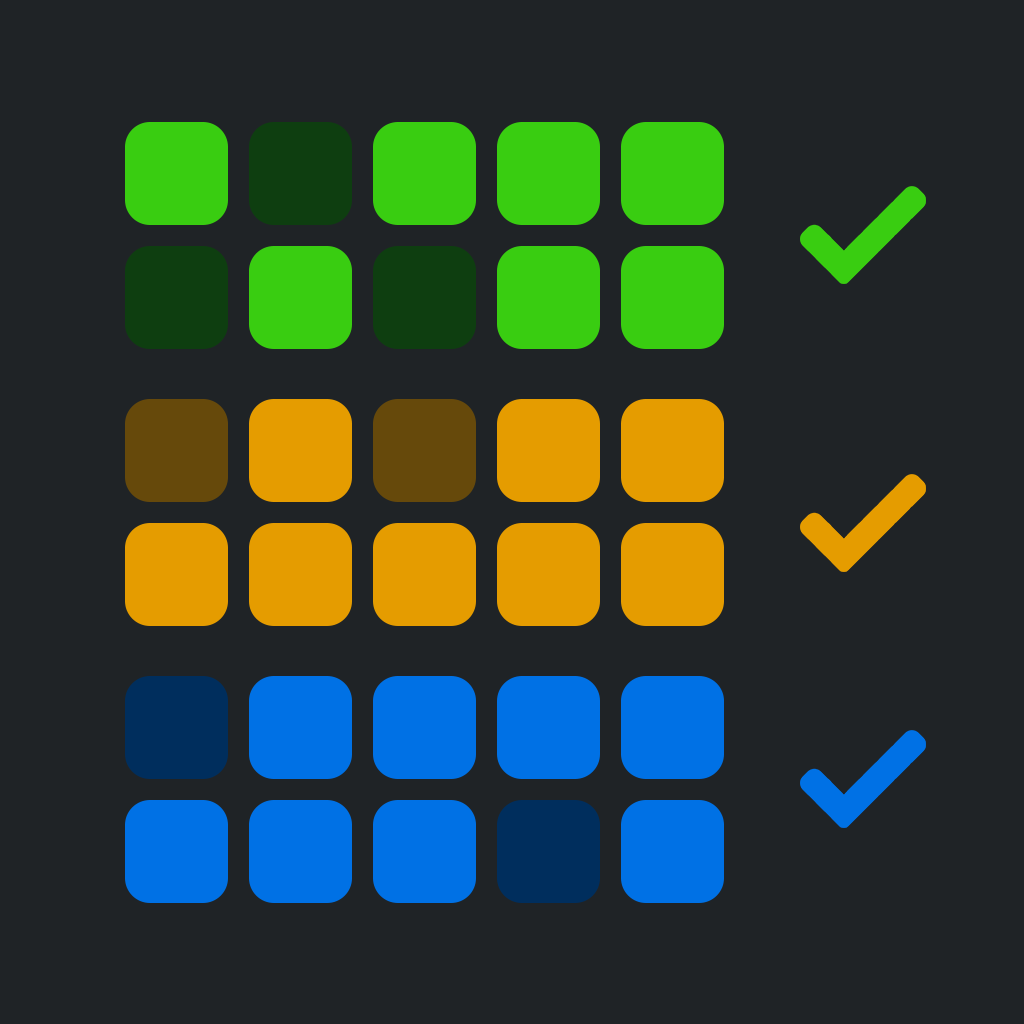
A full-year contribution grid gives you that at a glance — 75 consecutive filled squares, and any gap immediately obvious. The completion rate is the honest cross-check: if it says 96%, you missed days, and under 75 Hard’s own rules a missed day means the count restarted. Better to see that clearly than to reach day 70 and realise the streak was never intact.
One thing to be honest about
75 Hard has no rest days and no pauses, by design. That’s the challenge. So resist the urge to pause your 75 Hard habits for a holiday — the rules say a missed day is a restart, and a tracker that lets you quietly excuse days is telling you a comfortable story rather than the truth.
Vacation mode is genuinely useful for your other habits, the ordinary long-running ones you don’t want wiped out by a week away. Keep it away from this one. The value of 75 Hard is entirely in the fact that it doesn’t bend.
After the 75 days
Plenty of people finish the challenge and lose the routine within a fortnight, because the structure that was holding it up disappears overnight. If you want the fitness and reading habits to survive, the move is to lower the goals rather than delete the habits — drop the workout habit from 2 to 1, keep the reading at 10 pages, and let them run as normal habits.
Scheduled goal changes do this for you: set the new, smaller goal to take effect on day 76, and the history from the challenge stays intact behind it. The chain keeps going, at a size you can hold for a year instead of ten weeks.